Imagine trying to run a marathon while breathing exclusively through a narrow drinking straw. Your lungs would burn, your heart rate would skyrocket, and eventually, your body would collapse from the strain. This is exactly what happens to your heating and cooling system when it suffers from high static pressure.
While most homeowners worry about thermostat settings or refrigerant levels, static pressure is often the hidden culprit behind premature system failure, skyrocketing energy bills, and uneven cooling. It is the single most significant technical parameter in airflow dynamics, yet it is rarely discussed until something expensive breaks.
At Space Air Duct Cleaning, we believe in empowering homeowners with the technical knowledge to protect their investments. Understanding how static pressure interacts with your HVAC components can save you thousands of dollars in replacement costs and ensure your home remains safe and comfortable.
What is Static Pressure?
In the simplest terms, static pressure is the resistance to airflow within your heating and ventilation system. It is the pressure that the fan must overcome to move air through the ducts and out of the vents. It is measured in inches of water column (in. w.c.).
Every HVAC system is designed to operate within a specific pressure range, usually between 0.5 and 0.8 inches of water column. When the resistance exceeds this design limit, the system has to work exponentially harder to move the same amount of air. This excess struggle doesn’t just waste electricity; it physically tears your equipment apart from the inside out.
1. The Blower Motor: The Heart Attack of the System
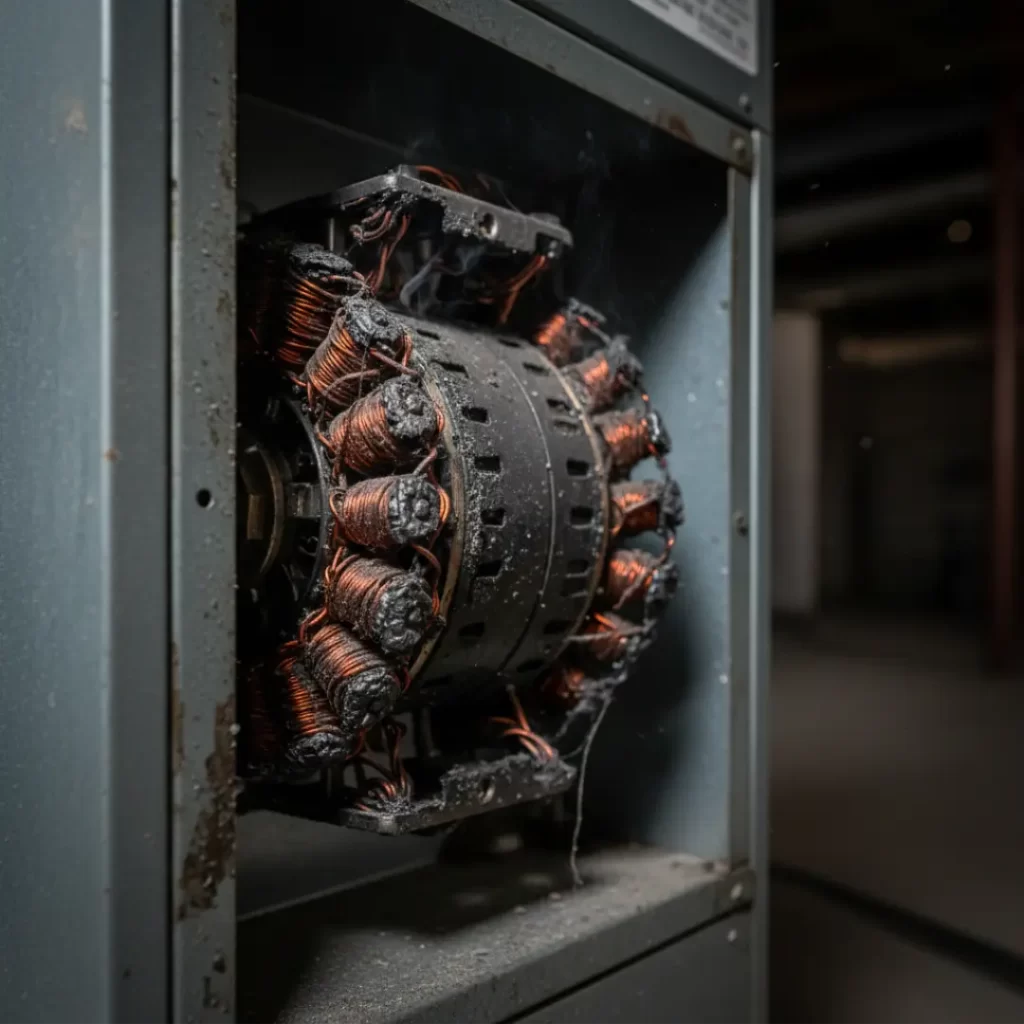
The component that suffers the most immediate and direct abuse from static pressure problems is the blower motor. This is the “heart” of your HVAC system, responsible for circulating air throughout the home.
The ECM Motor Dilemma
Modern HVAC systems often use Electronically Commutated Motors (ECM). These are “smart” variable-speed motors designed to maintain a specific airflow volume (CFM). When static pressure is high, due to a clogged filter or undersized ducts, the ECM detects the resistance and automatically ramps up its RPM to compensate.
While this ensures you still get air, it comes at a severe cost. The motor eventually runs at maximum capacity 100% of the time, leading to excessive heat generation and amperage draw. This is the mechanical equivalent of redlining your car engine constantly. Eventually, the windings inside the motor will fuse or the control module will fail, leading to a repair bill that can easily exceed $1,000.
PSC Motor Failure
Older systems use Permanent Split Capacitor (PSC) motors. Unlike ECMs, these motors cannot adjust their speed. When faced with high static pressure, a PSC motor simply cannot push the air. The airflow drops drastically, causing the motor to overheat because it relies on the moving air to cool itself.
2. The Heat Exchanger: A Dangerous Safety Risk
Perhaps the most alarming consequence of static pressure issues involves the furnace’s heat exchanger. This metal chamber is where the combustion gas (from burning natural gas or propane) heats the air that circulates into your home.
The heat exchanger relies on a steady stream of cool air passing over it to regulate its temperature. High static pressure restricts this airflow. Without enough air to strip the heat away, the metal of the exchanger overheats.
When the burner shuts off, the metal cools down rapidly. This constant cycle of extreme overheating and cooling causes the metal to expand and contract violently. Over time, this “thermal stress” creates cracks in the heat exchanger.
This is a critical safety hazard. A cracked heat exchanger can allow carbon monoxide, an odorless and deadly gas, to leak into your supply air and enter your living space. The Environmental Protection Agency (EPA) warns that ensuring proper ventilation and equipment maintenance is vital to preventing CO exposure. If a technician finds a crack caused by static pressure, they are legally required to shut down your furnace immediately.
3. The Compressor: Liquid Slugging and Failure
Static pressure doesn’t just affect your heating; it devastates your air conditioning as well. The health of your AC compressor (the outdoor unit) is directly tied to the airflow across the indoor evaporator coil.
When static pressure is high, airflow over the evaporator coil decreases. The refrigerant inside the coil needs that warm airflow to boil from a liquid into a gas. If there isn’t enough heat transfer because of low airflow, the refrigerant remains in a liquid state as it travels back to the outdoor compressor.
Compressors are designed to compress gas, not liquid. When liquid refrigerant enters the compressor, a phenomenon known as “liquid slugging”, it can destroy the valves and pistons inside. Furthermore, the lack of airflow can cause the evaporator coil to freeze into a block of ice, which completely blocks air and exacerbates the pressure problem, leading to a catastrophic system burnout.
4. Ductwork Leakage and Joint Failure
Air ducts are designed to handle a certain amount of pressure, but they are not pressure vessels. When the static pressure inside the supply plenum spikes, it looks for the path of least resistance.
High pressure pushes against the seams, joints, and seals of your ductwork. Over time, this can blow out tape, degrade mastic seals, and push duct connections apart. This leads to massive air leakage. according to the Department of Energy, typical duct systems already lose 25% to 40% of heating and cooling energy. High static pressure accelerates this loss, forcing your conditioned air into the attic or crawlspace rather than your living room.
Common Causes of High Static Pressure
Understanding the damage is the first step; identifying the cause is the second. Static pressure usually stems from airflow restrictions:
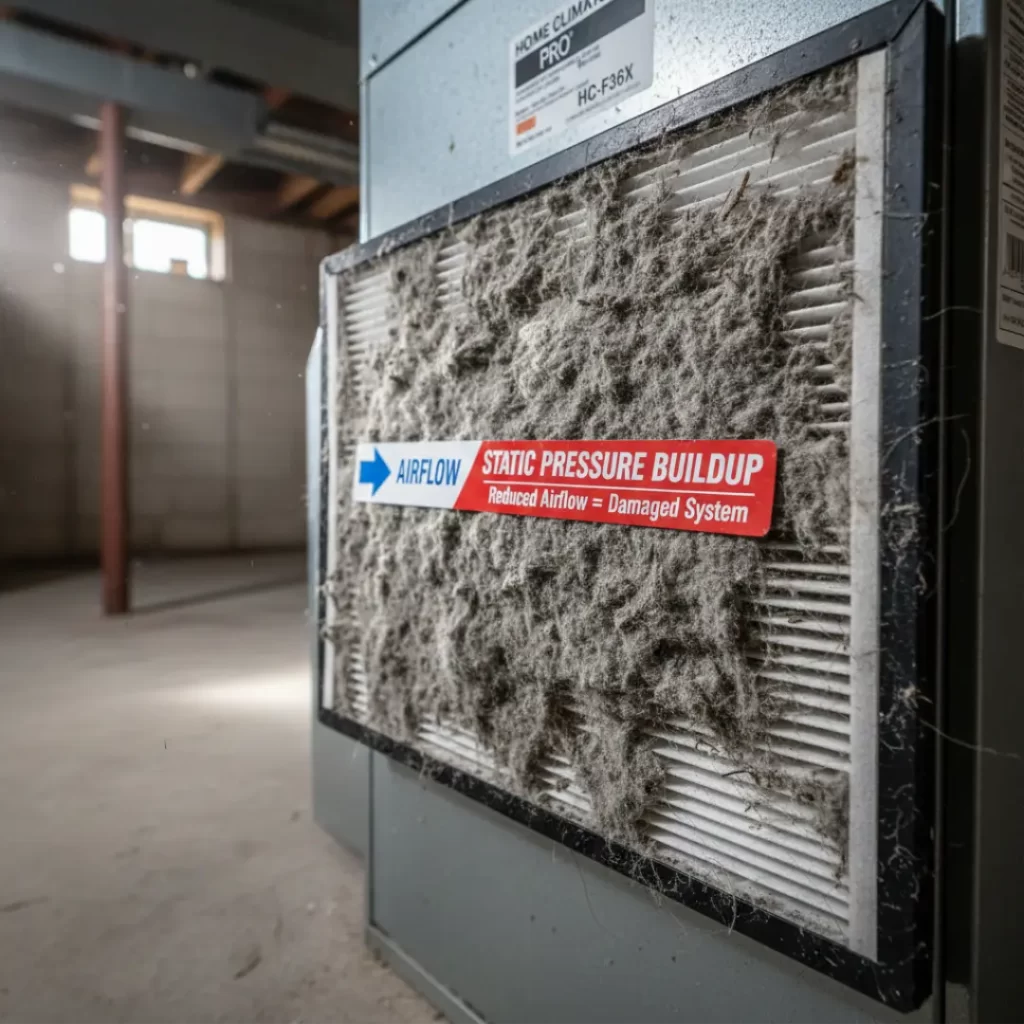
- Dirty Air Filters: The most common and easily fixable cause. A filter clogged with dust and pet dander acts like a brick wall to airflow.
- Dirty Air Ducts: Layers of dust, debris, and grime inside the ductwork narrow the passage, increasing friction and pressure.
- Undersized Ductwork: If your ducts are too small for the size of your AC unit (e.g., a 5-ton system on 3-ton ductwork), the air literally won’t fit, causing massive pressure spikes.
- Closed Vents: Many homeowners close vents in unused rooms thinking it saves energy. In reality, this increases pressure in the remaining system, potentially damaging the blower.
The Role of Professional Inspection and Cleaning
Diagnosing static pressure problems requires specialized tools, such as a manometer, to measure the pressure drop across the filter and the coil. However, the first line of defense is ensuring the path is clear.
This is where professional Air Duct Cleaning becomes a vital maintenance step, not just a hygiene service. By removing accumulated debris from the return and supply trunks, you reduce friction within the system. Furthermore, a professional cleaning service often serves as a diagnostic check-up. Technicians can identify crushed ducts, disconnected lines, or restrictive obstructions that are silently killing your equipment.
Maintaining a clean system allows your blower motor to run cooler, your heat exchanger to operate safely, and your compressor to last for its full intended lifespan.
Protect Your Investment with Space Air Duct Cleaning
Your HVAC system is likely the most expensive appliance in your home. Don’t let invisible pressure problems shave years off its life. If you notice your system is louder than usual, your energy bills are creeping up, or some rooms are consistently uncomfortable, it’s time for a professional assessment. At Space Air Duct Cleaning, we provide thorough cleaning and inspection services designed to optimize your airflow and protect your equipment.
Is your HVAC system struggling to breathe? Contact us today to schedule a comprehensive duct inspection and cleaning. Let us help you lower your energy bills and extend the life of your system.