
Calculating the correct duct size for your home is the difference between a cooling system that hums along efficiently and one that struggles against the sweltering Texas heat. In our experience, many homes near the historic streets of Highland Park suffer from uneven cooling because the original builders relied on guesswork rather than precision. To calculate ductwork accurately, you must determine the square footage of each room, calculate the total cooling load, and translate that into Cubic Feet per Minute (CFM) of airflow. Schedule your precision airflow audit today.
Before You Start: What Dallas Homeowners Must Know
To calculate ductwork for a house in Dallas, you must first perform a Manual J load calculation to determine how much cooling each room requires. This process accounts for window orientation, insulation levels, and local humidity factors common in the DFW metroplex. We use these figures to derive the required CFM for each room, ensuring the ductwork can handle the air volume without excessive noise or pressure. Properly sized ducts can reduce energy consumption by up to 25% according to industry standards.
Our team frequently encounters homes in the Uptown area where renovations have added rooms without updating the central plenum. Before you touch a single piece of sheet metal, you need to know the total tonnage of your AC unit. A standard rule is that a system requires roughly 400 CFM per ton of cooling capacity. If you have a 3-ton unit, your main trunk line must be capable of moving 1,200 CFM. However, calculating for indoor air quality improvement requires looking beyond just the numbers; you must also consider the path of least resistance for the air.
Local building codes in Dallas have become stricter regarding duct leakage and insulation values. If your project involves a bungalow near Lower Greenville, you might be required to use R-8 insulated flex duct in unconditioned attic spaces. We recommend checking with the U.S. Department of Energy guidelines for specific regional climate zone requirements. This ensures your calculations meet both comfort and legal standards.
The Step-by-Step Process
Calculating ductwork involves a linear progression from heat load analysis to physical pipe sizing. First, determine the total heat gain for the building, then divide the room-by-room load by the total load to find the percentage of air each space needs. Finally, use a duct calculator or “ductulator” to set the friction loss per 100 feet, typically 0.1 for residential systems. Following this method prevents the common “hot room” syndrome found in many older North Richland Hills residences.
- Measure Square Footage: Calculate the area of every room, including ceiling heights. A vaulted living room in Lakewood requires significantly more air than a standard bedroom.
- Calculate Heat Load: Use Manual J software to account for North Texas sun exposure. This is where you determine the BTU requirements for each specific zone.
- Determine CFM per Room: Multiply the total system CFM by the percentage of the total heat load that the room represents. This ensures HVAC system efficiency is balanced throughout the house.
- Establish Static Pressure: Check the manufacturer’s data for your blower motor to see how much negative pressure it can handle. This dictates how “tight” or “loose” your duct design can be.
- Size the Trunk and Branches: Use your CFM totals to select the diameter of your round ducts or the dimensions of your rectangular trunks. For a quiet system near Downtown Dallas, keep air velocity below 700 feet per minute in branch ducts.
When we perform an air duct repair, we often find that the friction rate was set too high during the initial design. If the friction rate is too high, the air will be noisy and the motor will burn out. Conversely, if it is too low, the air won’t reach the furthest rooms in your Plano estate. Balancing this requires a deep understanding of the National Air Duct Cleaners Association (NADCA) standards for airflow and cleanliness.
The 4 Mistakes That Cost Dallas Homeowners the Most
The most expensive mistakes in ductwork calculation involve ignoring the return air path and using incorrect materials for the environment. Many installers fail to account for the static pressure drop caused by high-efficiency HEPA filters, which can choke an otherwise well-designed system. In the DFW area, leaky ducts can waste up to 30% of your energy bill, making precision calculation a financial necessity rather than a luxury. Avoiding these errors protects your equipment and your wallet.
- Undersized Return Air: A system that cannot “breathe” will hunt for air, pulling dust and allergens from your attic or crawlspace near Highland Park.
- Excessive Flex Duct: Stretching flex duct too tight or leaving too many loops creates massive airflow obstructions that traditional calculations rarely account for.
- Ignoring the Plenum: The plenum box is the heart of the system; if it is sized incorrectly, the plenum boxes will create turbulent air that never makes it into the supply lines.
- Forgetting the Filter Pressure Drop: If you plan on installing a UV air purifier or a thick media filter, you must adjust your duct sizing to compensate for the added resistance.
In our work across Forney and Garland, we see the consequences of these mistakes daily: high utility bills, dusty surfaces, and a cooling system that never turns off. The technical step-by-step process we use involves verifying the actual delivered CFM at each register using a flow hood, a step most competitors skip to save time. This verification ensures the indoor air quality improvement we promise is actually delivered.
When to Stop DIY and Call a Professional in Dallas
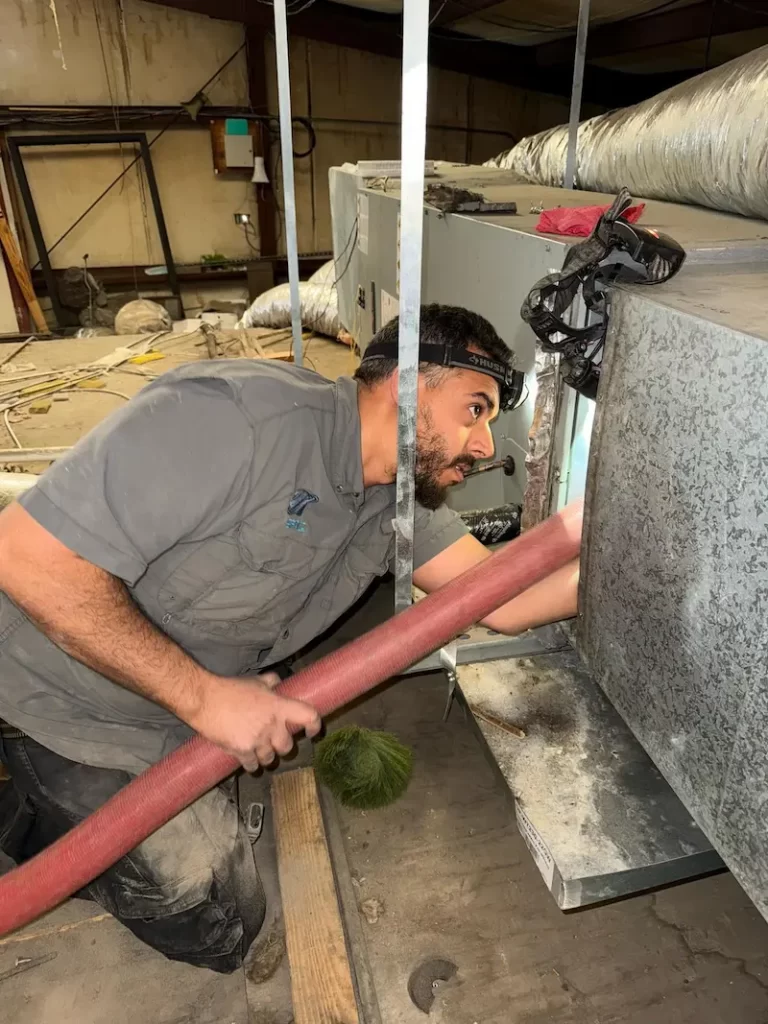
While basic calculations can be done by a dedicated homeowner, complex layouts involving multiple zones or commercial space air duct cleaning needs require specialized tools and training. If your home has complicated rooflines near Deep Ellum or requires ductwork sanitization alongside a redesign, a professional evaluation is essential. We use high-powered diagnostic equipment and HEPA filtration vacuums to ensure your system is not only sized correctly but remains clean and efficient for years to come.
| Feature | Space Air Duct Cleaning | Typical Competitor |
|---|---|---|
| Pricing Transparency | ✅ Honest, upfront estimates with no hidden fees | ❌ Vague quotes that change on-site |
| Verification Process | ✅ Before/After photos & CFM data for every job | ❌ “Trust us” approach with no visual proof |
| Technical Expertise | ✅ NADCA certified & specialized in manufacturing IAQ | ❌ Residential-only focus with basic tools |
Our team understands that a commercial space air duct cleaning Dallas project has very different requirements than a residential one near Coppell. We leverage the most powerful vacuum systems on the market to ensure that your new ductwork doesn’t become a breeding ground for dust or mold from day one. Unlike competitors who might suggest a total replacement, we never recommend duct replacement if a simple cleaning and repair will restore your system to peak performance. Our goal is long-term reliability for your HVAC duct cleaning Dallas TX needs.
Whether you are dealing with a drafty home near Fair Park or need to optimize the airflow for a manufacturing facility near DFW Airport, our technicians are background-checked and drug-tested for your peace of mind. We take pride in serving the Dallas community with integrity. Call us now for a comprehensive system analysis.
Frequently Asked Questions
How do I know if my ductwork is undersized for my Dallas home?
Common signs of undersized ductwork include excessive air noise at the vents, frequent AC cycling, and “hot spots” in rooms far from the air handler. In Dallas, 90% of residential systems suffer from some form of airflow restriction. Air Duct Cleaning Dallas Tx | Space Air Duct Cleaning can perform a static pressure test to verify your system’s health.
How much does it cost to have a professional calculate and clean my ducts in Dallas?
Professional inspections and basic cleaning usually range from $300 to $800 depending on the size of your home and the complexity of the layout. We provide transparent, upfront pricing after a thorough on-site evaluation of your system’s needs. Contact us for a free quote today.
Is Space Air Duct Cleaning licensed to work in Dallas TX?
Yes, we are a NADCA certified company and our technicians undergo rigorous training and background checks. We maintain 16+ years of combined expertise in improving indoor air quality for homes and businesses across the Dallas area. You can trust our team for professional, reliable service.
What areas near Dallas do you provide ductwork services for?
We serve the entire DFW metroplex, including Uptown, Highland Park, and Lower Greenville. Our reach extends to suburbs like Carrollton, Plano, and Fort Worth. If you are near a local landmark like White Rock Lake, we can typically provide same-day or next-day consultations. Book your appointment online to secure your spot.