Many homeowners believe that closing vents in unused rooms is a smart way to save money and “direct” air to the rooms they use most. It seems logical: if you aren’t using the guest bedroom, why pay to heat or cool it? However, modern HVAC systems are not designed to operate this way. In fact, closing too many vents can lead to catastrophic mechanical failure, higher energy bills, and poor indoor air quality.
At Space Air Duct Cleaning, we see the long-term effects of restricted airflow every day. Understanding the physics of your home’s ventilation is the first step in protecting one of your most expensive household investments.
The Myth of “Redirecting” Airflow
A common misconception is that your HVAC system acts like a water hose, if you pinch one end, the pressure increases at the other. In reality, your furnace or air conditioner is designed to move a very specific volume of air, measured in Cubic Feet per Minute (CFM). When you close registers, you aren’t telling the system to work less; you are forcing it to work against much higher resistance.
When airflow is restricted, the blower motor must work significantly harder to push air through a narrowed path. This creates static pressure within the ductwork. Think of it like trying to breathe through a straw while running, your lungs (the blower motor) will eventually strain and fail under the added pressure.
How Restricted Vents Damage Your Equipment
The mechanical consequences of closing vents are often invisible until a major breakdown occurs. Because your system was sized specifically for the total square footage and duct capacity of your home, altering that balance can lead to several expensive issues.
1. Frozen Evaporator Coils
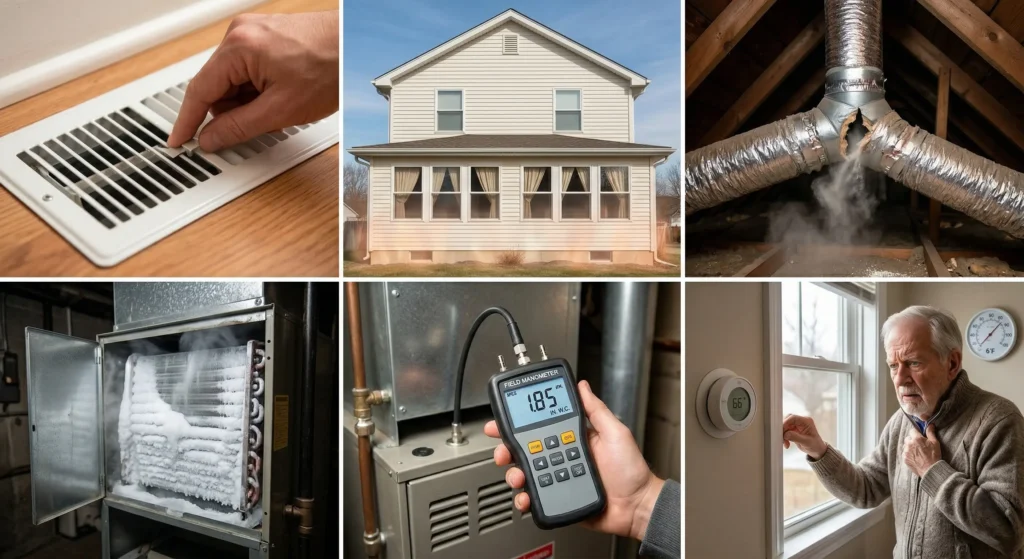
During the summer, your air conditioner relies on a steady stream of warm indoor air blowing over the cold evaporator coils to keep them from getting too chilly. If you close too many vents, the air volume drops. Without enough warm air to absorb the cold, the temperature of the coils can plummet below freezing, causing ice to build up. This ice blocks airflow entirely and can lead to liquid refrigerant “slugging” back into your compressor, which often results in a total system replacement.
2. Heat Exchanger Cracks
In the winter, a lack of airflow is even more dangerous. Your furnace’s heat exchanger needs constant air movement to stay within a safe operating temperature. According to the U.S. Department of Energy, restricted airflow can cause the heat exchanger to overheat. Over time, this repeated overheating causes the metal to expand and contract excessively, leading to hairline cracks. A cracked heat exchanger can leak carbon monoxide into your home, a silent and deadly safety hazard.
3. Short Cycling
When pressure builds up, the system may detect that it is overheating or freezing and shut itself off prematurely. This is known as “short cycling.” Instead of a long, efficient cooling or heating cycle, the system turns on and off rapidly. This significantly increases wear and tear on the electrical components and the blower motor, leading to a much shorter lifespan for your HVAC unit.
The Impact on Duct Integrity and Air Quality
It isn’t just the mechanical unit that suffers; your ductwork itself can be damaged by the excess pressure caused by closed vents. Most residential ductwork is not 100% airtight. When you close registers, the internal pressure increases, which can turn small, existing leaks into major gaps.
According to research from Lawrence Berkeley National Laboratory, the average home loses about 20% to 30% of the air that moves through the duct system due to leaks, holes, and poorly connected ducts. By closing vents, you are actively pushing more of your expensive conditioned air into your attic, crawlspace, or behind walls through these forced-open gaps.
Furthermore, this high-pressure environment can disturb settled dust and debris within the ducts. As the air struggles to find an exit, it can blow particulates back through the open vents at a higher velocity, degrading your indoor air quality and triggering allergies.
The Financial Reality: Are You Actually Saving Money?
The short answer is: No. While you might think you are saving on your utility bill, the increased static pressure usually results in higher energy consumption. Because the system is short-cycling and fighting against resistance, it runs less efficiently.
Additionally, the cost of a premature blower motor replacement or a cracked heat exchanger far outweighs any marginal savings you might see on a monthly bill. Maintaining balanced airflow is the most cost-effective way to manage a home’s climate.
Professional Airflow Optimization and Maintenance
At Space Air Duct Cleaning, we specialize in restoring the mechanical harmony of your ventilation system. Our approach goes beyond simple cleaning; we focus on the overall health and functionality of your air delivery path.
Specialized Airflow Assessment
Our technicians use advanced diagnostic tools to measure the static pressure within your system. We can identify if your current vent configuration or dust accumulation is causing a “chokepoint” that threatens your equipment. This level of technical mastery ensures that your system isn’t just clean, it’s optimized.
High-Power Debris Removal
If your vents have been closed for long periods, dust and moisture can settle and harden in the stagnant areas of your ductwork. We utilize industrial-strength agitation tools and HEPA-filtered extraction to clear these blockages, ensuring that when you do open your vents, the air flowing into your home is pure and unobstructed.
Duct Sealing and Sanitization
To combat the leaks caused by high-pressure environments, we inspect for structural compromises in your ducts. By cleaning and then treating the system with antimicrobial agents, we ensure a healthy environment that supports the longevity of your HVAC unit. This field-tested proficiency is why homeowners trust us to handle their complex indoor air systems.
Better Alternatives to Closing Vents
If you have rooms that are too hot or too cold, there are better ways to manage your home’s temperature without damaging your equipment:
- Use a Zoning System: If your home has a multi-zone HVAC setup, use the dampers specifically designed to manage airflow safely.
- Keep Vents 75% Open: If you absolutely must restrict air in a room, never close the vent completely. Keeping it at least partially open allows for some pressure relief.
- Install a Smart Thermostat: Devices recommended by Energy Star can help manage your home’s temperature more efficiently than manual vent adjustments.
- Regular Duct Cleaning: Ensuring your return and supply lines are free of debris is the single best way to maintain low static pressure and high efficiency.
Restore the Breath of Your Home Today
Your HVAC system is a precision-engineered machine that requires a delicate balance of pressure and flow to keep your family comfortable. If you have been closing vents to save money, or if you notice your system struggling to keep up, it is time for a professional intervention. Space Air Duct Cleaning provides the high-level diagnostic and cleaning services needed to protect your equipment and improve your air quality simultaneously. Don’t wait for a costly system failure, contact our experienced team today to schedule a comprehensive airflow inspection and professional duct cleaning that will lower your energy risks and breathe new life into your home.